Feeling lost in your 30s: you may be stuck, not lost
Feeling lost in your 30s can mean having no direction or being locked into a life that no longer fits. A qualitative four-phase map separates them.

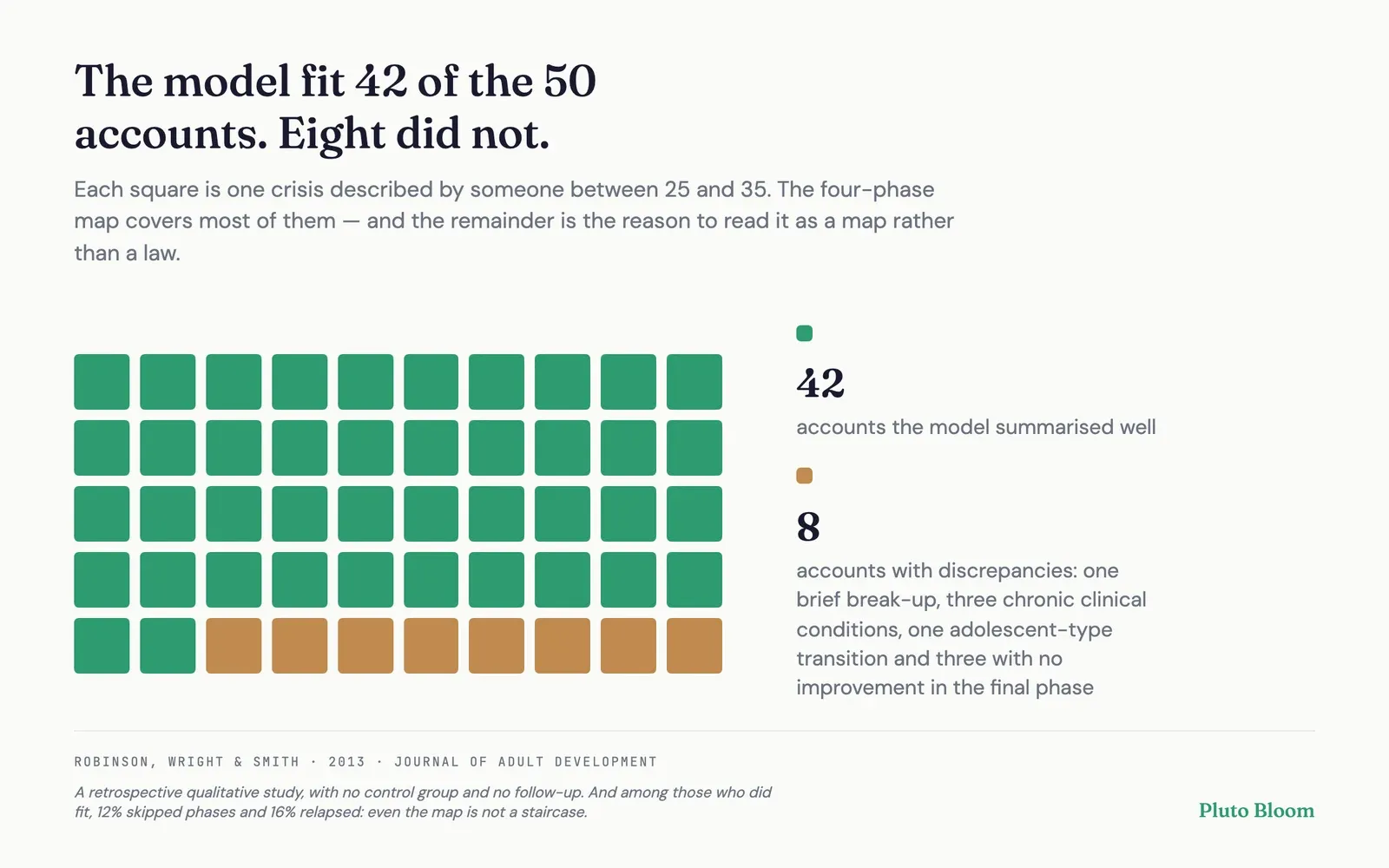
The authors built a four-phase model from 50 retrospective interviews and judged it a good summary of 42 accounts. They tested no advice and conducted no prospective follow-up.
Feeling lost in your 30s can mean two things: you see no direction, or you know what you no longer want but remain bound to it. The second is not really lostness; it is being stuck inside a commitment that no longer fits. A qualitative model from Robinson, Wright, and Smith (2013) helps name that difference, but it maps remembered experiences rather than sorting people into universal stages.
Lost and locked-in are different problems
Lostness begins with a blank: no option has enough shape to become a direction. Being locked-in begins with a conflict: one part of your life is clear enough to reject, yet costly or difficult to leave. Both produce indecision. Only one contains an established commitment that keeps operating after it has stopped feeling chosen.
It can be a stable job, a relationship built into every practical decision, or an identity that once earned approval. Nothing has to collapse before it stops fitting. If the decade marker is delivering the verdict, why birthdays ending in 9 hit different examines that countdown. The locked-in question is whether a settled-looking life still feels chosen.
The study produced a map, not a law of your thirties
Robinson, Wright, and Smith (2013) conducted a qualitative study: 50 retrospective interviews, not an experiment or a representative survey. There was no control group, baseline measure, or prospective follow-up. The researchers organized completed stories into a shared model. That can reveal recurring narrative structures. It cannot estimate prevalence or show that one phase causes the next.
The sample included 25 men and 25 women recruited around London; 44 were White. They were paid volunteers drawn through university and non-university networks, not a representative sample. Interviews lasted 45 to 60 minutes and covered episodes experienced from ages 25 to 35. Each episode had lasted at least a year, disrupted work or home life, and improved or concluded at least one year earlier.
Those criteria shape the finding. The supplied definition already framed the episode as a turning point and period of change. The researchers heard stories formed with hindsight; they did not watch unresolved episodes unfold. Nor did they isolate age 30.
Phase 1: the life still works, but no longer feels chosen
The authors called the first phase Locked-in. A relationship, career, or other adult commitment was no longer wanted, but changing it did not yet seem realistic. Participants described powerlessness and restriction rather than a total absence of preferences. They often knew which part of the arrangement they rejected. What they lacked was a viable way to alter it.
Identity had adapted to the role: reliable employee, settled partner, person who does not disappoint the family. The public version still made sense while the private one had moved elsewhere. The authors described those commitments as typically adopted through external pressure, duty, or passive drift rather than intrinsic motives.
This differs from going through the motions, where the blurred weeks may be hard to notice. Locked-in begins after something has been noticed. The question becomes: “What am I maintaining even though I would not choose it again?”
Phase 2: the old commitment ends and identity lags behind
Phase 2 combines Separation and Time-out: detaching mentally or physically from the old commitment, then spending time without a replacement. The paper places peak emotional intensity in Separation, not in Locked-in. Relief, guilt, sadness, anxiety, excitement, and shame could occupy the same stretch of an account.
The order varied. Some people accepted that leaving was possible before ending the relationship or job. For others, the external loss arrived before the inner separation. Either route could produce an identity vacuum: the old answer to “Who am I?” had disappeared before a new one existed.
Time-out meant distance, reflection, and temporary avoidance of commitments. It could precede or follow final separation. Even Phase 2 is not a rigid staircase. If everything feels more intense than clear, the previous structure may still be coming apart.
The Monday letter brings one idea and its limits, so you can think more precisely without turning a map into an instruction.
Phase 3: uncertainty comes from live options, not a blank future
In Exploration, participants were no longer mainly describing an exit. They were testing jobs, training, relationships, or environments without treating the first possibility as a destination. Identity became more provisional and open to revision. Anxiety remained, but it appeared alongside excitement about options that the previous structure had excluded.
This can feel like lostness because no answer is final, but there are experiments, comparisons, and curiosity. Several doors are visible; none yet deserves a long commitment. The study did not compare guidance or establish that more exploration produces better results. The label names the uncertainty without turning it into an order.
Phase 4: commitment returns without a guaranteed resolution
Rebuilding described renewed long-term commitments: a job, relationship, or way of living presented as closer to personal interests and values. Many participants narrated greater intrinsic motivation, purpose, and daily enjoyment. That is the model’s positive trajectory. It was not a universal ending, and no before-and-after scale measured the improvement.
Three participants reported no increase in enjoyment, well-being, or intrinsic motivation. All had children and took work that could support them. That does not show parenthood caused the outcome. It shows that material constraints can disrupt the clean resolution implied by a diagram.
Real accounts skipped phases, relapsed, and resisted the map
The model includes routes that break its clean sequence. Six of the 50 participants, 12%, moved from Separation to Rebuilding without a clear Time-out or Exploration period. Eight, 16%, entered a new commitment that became restrictive and returned to another separation. The authors called these routes fast-forward and relapse.
Those percentages describe the sample, not the population. They have no confidence intervals or external comparison, and the loops could overlap. The researchers judged the model a good summary of 42 accounts, or 84%. The eight discrepancies included one short episode, three stories with persistent difficulties, one transition from family dependence, and three rebuildings without the expected outcome. Omitting them would make the evidence cleaner than the paper.
Knowing where you are does not tell you what to do
The model’s careful value is linguistic. It can replace “I have no idea what to do” with a narrower description. You may still be inside something you no longer choose. The exit may have happened while intensity fills the available space. You may be testing possibilities or already building a new commitment. None of those labels decides whether to stay, leave, wait, or choose.
Robinson, Wright, and Smith tested no phase-specific advice, assigned no different guidance, and did not follow participants forward. Saying that Locked-in requires one recommendation while Exploration makes it wrong is outside the study.
The map can correct the scale. “What should I do with my life?” asks for a total design. “What kind of uncertainty am I in?” can be answered from the present. It does not solve the larger question; it stops treating constraint, separation, trial, and renewal as the same uncertainty.
Frequently asked questions
Does a crisis in your 30s always have four phases? No. The researchers built this model from 50 retrospective interviews and judged it a good summary of 42 accounts. Some people skipped phases, doubled back, or did not fit. The episodes occurred between ages 25 and 35, so the paper did not establish a universal crisis tied specifically to turning 30.
How can I tell whether I am lost or stuck? This paper provides no validated test. The distinction is descriptive. Lostness means no direction has enough shape. Being stuck means you recognize what you no longer want while duty, dependence, or a possible loss keeps the structure in place. You can partly recognize yourself in both.
Does identifying a phase tell me which decision to make? No. The study tested no advice and compared no outcomes produced by particular guidance. A phase may give you vocabulary for the present, but it does not contain your resources, responsibilities, relationships, or risks. The map organizes a story; it cannot make the judgment that story requires.
A more exact word changes the question
“I am lost” makes an entire life a place without coordinates. “I am inside something I no longer want” identifies a structure. “I left, and I do not know who I am outside it” identifies another. None supplies an answer, but each keeps the search from happening in the wrong place.
At 30, the pressure demands a full plan. This study offers something smaller: four ways an adult life can stop fitting and reorganize, including detours. Before deciding what comes next, it helps to know whether no path is visible or one path is already clear because you no longer want it.
References
- Robinson, O. C., Wright, G. R. T., & Smith, J. A. (2013). The holistic phase model of early adult crisis. Journal of Adult Development, 20(1), 27–37.
Double confirmation: you get an email and decide. One-click unsubscribe, anytime.